
Battery vs Hardwired Touchless Faucets
Choosing the right power system for commercial touchless faucets affects installation cost, restroom uptime, maintenance planning, water control, and long-term building operations. Here is a practical guide for office buildings, airports, schools, hospitals, hotels, restaurants, and other public facilities.
Quick Answer
- Battery-powered touchless faucets are usually best for retrofits, small restroom upgrades, leased spaces, and projects where adding electrical work would slow the schedule.
- Hardwired touchless faucets are usually best for new construction, high-traffic buildings, large restroom portfolios, and locations where maintenance teams want fewer battery replacement rounds.
- Hybrid or backup power is the safest choice for hospitals, airports, large campuses, and mission-critical restrooms where a dead battery or power outage can disrupt service.
Why Faucet Power Matters
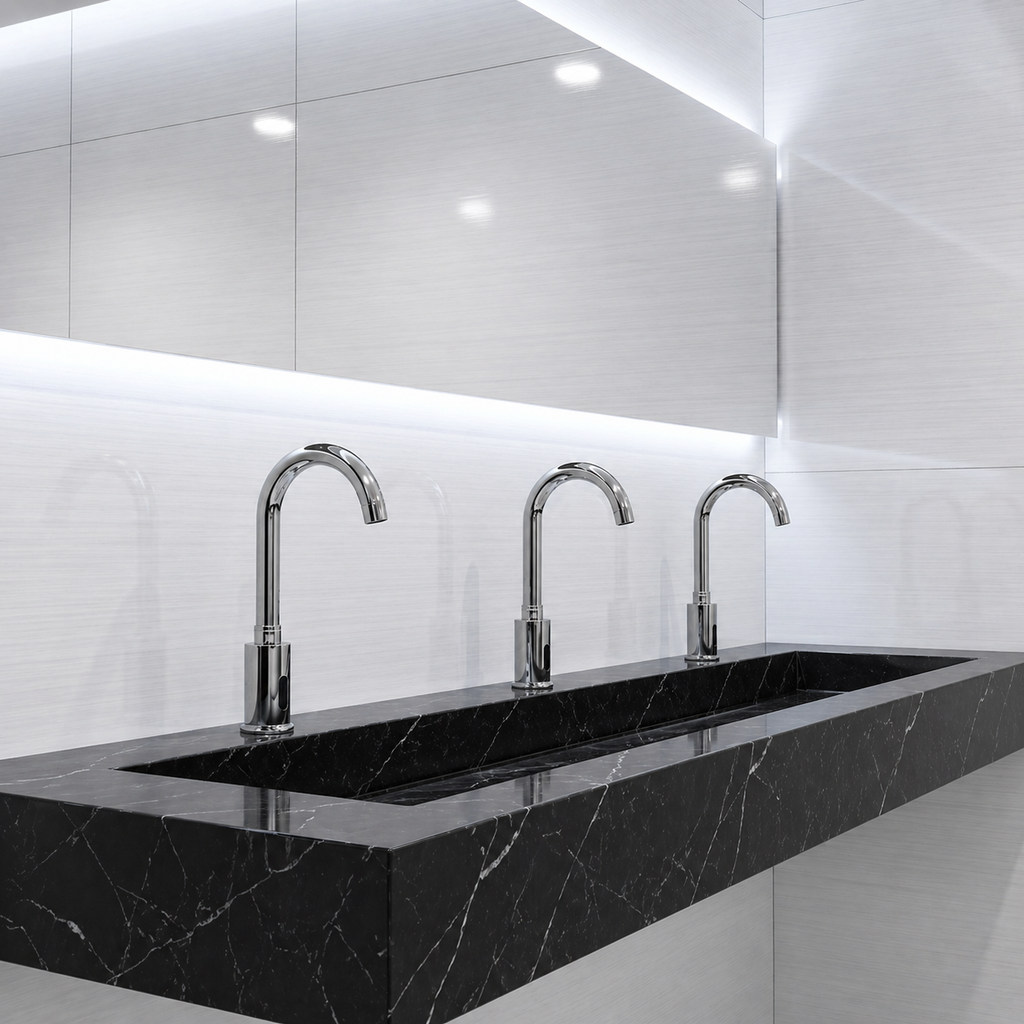
A touchless faucet is more than a spout with a sensor. It is a small electronic system that needs reliable power to operate the sensor, solenoid valve, control module, and sometimes Bluetooth or building-management features. In a commercial building, that power choice can change the project budget, restroom downtime, maintenance routine, and user experience.
The faucet power decision is especially important because commercial restrooms are not used like home bathrooms. Public lavatories may serve hundreds or thousands of handwashing cycles per day. A faucet that works well in a private restroom may create maintenance problems in an airport, school, stadium, hospital, or office tower if the power system is not matched to the traffic level.
Water efficiency should also be specified separately from sensor activation. A touchless faucet can reduce touchpoints and help control run time, but the actual water result depends on flow rate, sensor range, timeout settings, laminar or aerated outlet, water pressure, and maintenance. The U.S. Department of Energy notes that public lavatory retrofits commonly target 0.5 gpm flow devices, while EPA WaterSense bathroom faucet guidance centers on high-performing, water-efficient faucet products.
Battery Touchless Faucets
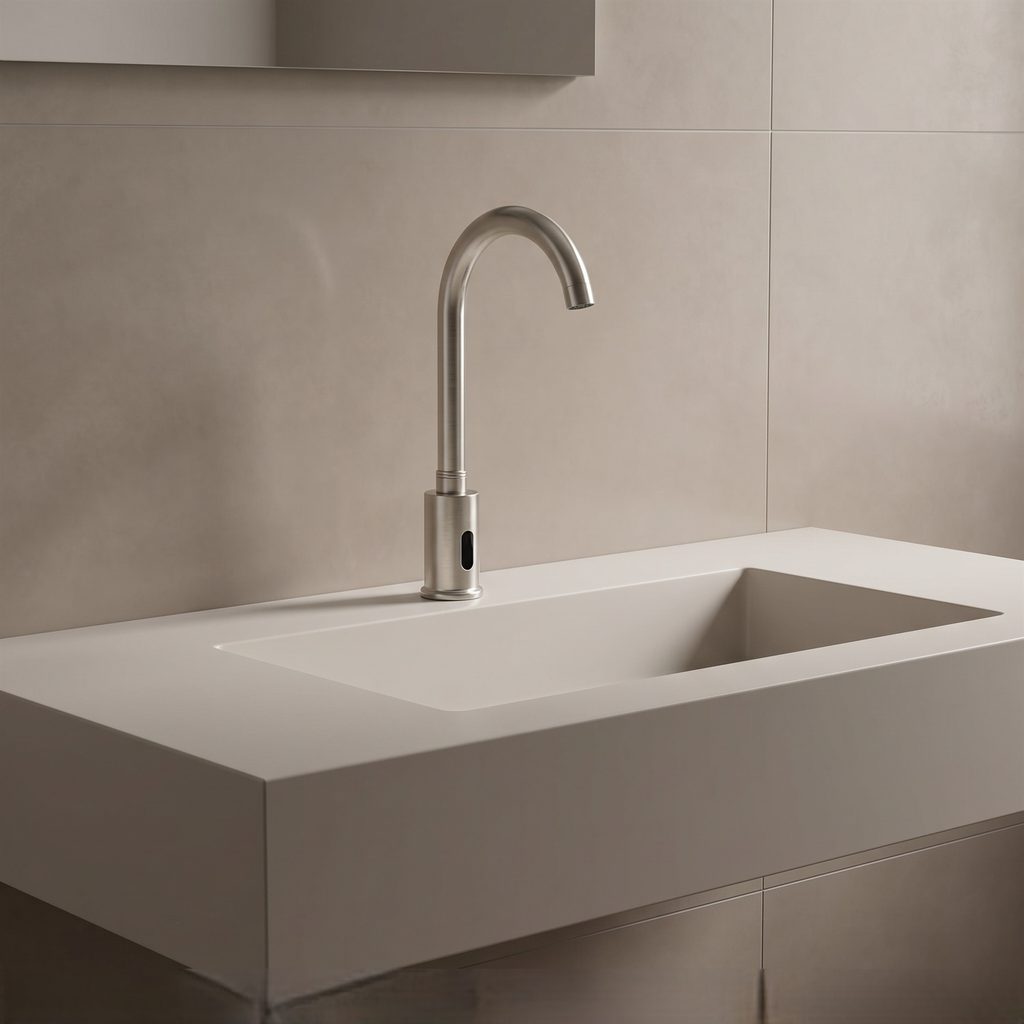
Battery-powered touchless faucets use replaceable batteries, commonly AA, C-cell, D-cell, lithium packs, or manufacturer-specific power modules. They are popular in commercial restroom retrofits because they do not require a new outlet under the sink, a hardwired transformer, or coordination with an electrician.
For existing buildings, this is the biggest advantage. A facility team can often replace manual faucets with sensor faucets while keeping the original sink deck, supply lines, and many parts of the restroom layout. That makes battery systems attractive for restaurants, retail stores, office restrooms, tenant improvements, schools, and older buildings where opening walls or running conduit would be expensive.
Where Battery Power Works Best
- Retrofit projects where electrical work would add cost or delay.
- Small commercial restrooms with moderate daily use.
- Leased spaces where permanent electrical changes are limited.
- Buildings with many restroom types and a need for flexible installation.
- Locations where power outages are common and battery operation is preferred.
Hardwired Touchless Faucets
Hardwired touchless faucets use building power through a transformer, plug-in adapter, or dedicated low-voltage wiring system. They are often selected for new commercial construction, major restroom renovations, airports, hospitals, universities, office towers, and other high-use facilities where long-term maintenance planning matters more than the lowest initial installation complexity.
The primary advantage is consistency. A hardwired faucet does not depend on routine battery replacement for normal operation. When the electrical design is planned early, power can be coordinated with the sink system, access panels, GFCI protection where required, maintenance clearances, and other restroom equipment such as soap dispensers or hand dryers.
Hardwired systems can cost more during installation because they may require electrical rough-in, transformer locations, outlets, or coordination between the plumbing and electrical trades. But in a large building with dozens or hundreds of faucets, avoiding repeated battery replacement can simplify facility operations over time.

Where Hardwired Power Works Best
- New construction where electrical rough-in is already planned.
- High-traffic buildings with many daily handwashing cycles.
- Large restroom portfolios where battery replacement labor becomes costly.
- Facilities with preventive maintenance teams and standardized parts programs.
- Projects that require connected monitoring, programming, or long-term service consistency.
Battery vs Hardwired Chart
The best power system depends on the project type. The chart below compares the two common options for commercial sensor faucets. Scores are general planning scores, not a substitute for manufacturer documentation, electrical code review, or site-specific cost estimating.
| Category | Battery-Powered Faucet | Hardwired Faucet | Best Fit |
|---|---|---|---|
| Retrofit speed | Usually faster because no dedicated electrical rough-in is needed. | May require outlet, transformer, conduit, or electrician coordination. | Battery |
| New construction | Works, but may not be the most efficient long-term choice for large projects. | Easy to plan during design and rough-in when plumbing and electrical trades are already on site. | Hardwired |
| High traffic | Can work if batteries are long-life and maintenance is disciplined. | Usually preferred because daily operation does not depend on battery replacement cycles. | Hardwired |
| Power outage behavior | Can continue operating if batteries have charge. | Stops during outage unless the product includes battery backup or emergency power. | Battery or Hybrid |
| Maintenance | Requires battery checks, replacement inventory, and documentation. | Reduces battery rounds but still needs sensor, outlet, solenoid, strainer, and flow-control service. | Hardwired |
| First cost | Often lower when replacing manual faucets in existing restrooms. | Can be higher if new electrical infrastructure is needed. | Battery |
| Lifecycle cost | Depends on battery life, traffic level, labor rate, and number of faucets. | Often stronger for large sites because it reduces repeated battery labor. | Hardwired |
Planning Scorecard
Simple Case Model
Consider a six-floor office building with 60 commercial touchless faucets. A battery-powered retrofit may be attractive because installation can move quickly and avoid new wiring. But the facility team must track every faucet, battery type, installation date, low-battery indicator, and replacement interval.
If each faucet uses a four-battery pack, the building may need to manage 240 individual batteries per full replacement cycle. If replacement is handled reactively, staff may only learn about low batteries when a tenant reports a faucet that will not activate. That creates a restroom experience problem, not just a maintenance task.
In the same building, a hardwired system may cost more during renovation because power must be coordinated below the sink. Once installed, however, the maintenance team can focus on sensor calibration, aerator cleaning, strainer checks, and solenoid service rather than battery inventory. For a large restroom portfolio, that difference can justify the higher up-front coordination.
Case Takeaway
For a small retrofit, battery power often wins. For a large building with many identical restrooms, hardwired power often becomes easier to manage. For healthcare, airports, and critical public facilities, specify hardwired power with battery backup or another emergency power strategy when uninterrupted handwashing is important.
Best Choice by Building
| Building Type | Recommended Power System | Reason |
|---|---|---|
| Small office | Battery or plug-in | Simple retrofit, moderate use, and easier installation. |
| Large office tower | Hardwired or hybrid | Many fixtures make battery rounds more labor-intensive. |
| Airport | Hardwired with backup | High traffic, long operating hours, and high user expectations. |
| Hospital or clinic | Hybrid or hardwired with backup | Hand hygiene access is operationally important, and outages should not disable faucets. |
| School | Battery for retrofit; hardwired for new build | Battery works for phased upgrades, while new construction can standardize hardwired service. |
| Restaurant | Battery or hardwired | Depends on wall access, under-sink outlet availability, and inspection requirements. |
| Stadium or venue | Hardwired with backup | Heavy surge traffic makes uptime and rapid service access more important. |
| Hotel lobby restroom | Hardwired or premium battery | Guest-facing restrooms need reliable activation and clean aesthetics. |
Spec Checklist
Before choosing battery or hardwired commercial sensor faucets, review the full restroom system. Power is only one part of performance.
Professional Recommendation
For most commercial buildings, the best answer is not simply “battery” or “hardwired.” The best answer is a power strategy. Use battery faucets where installation flexibility matters, hardwired faucets where long-term uptime matters, and hybrid backup where restroom failure would create operational risk.
Technical Notes
Most commercial touchless faucets use an infrared or capacitive sensor to detect hands, then open a solenoid valve for a programmed period or while hands remain in the detection zone. Power stability affects how reliably that sensor and valve operate. Weak batteries can cause slow response, intermittent activation, or low-battery alerts. Electrical disruption can stop hardwired faucets unless backup power is included.
Flow control should be chosen carefully. Public lavatories often use lower-flow outlets than private bathroom sinks, and many commercial products offer 0.5 gpm, 0.35 gpm, 1.0 gpm, or 1.5 gpm options depending on code, application, and user expectations. A lower flow rate can reduce water consumption, but the basin, spout reach, sensor timing, soap location, and splash pattern must still support comfortable handwashing.
In healthcare and clinical spaces, touchless faucets should be viewed as part of a larger hand hygiene system. CDC guidance emphasizes appropriate hand hygiene supplies, soap-and-water access when hands are visibly soiled, and proper handwashing technique. Faucet power should therefore support reliable access, not become a weak point in the room.
FAQ
Are battery-operated touchless faucets good for commercial buildings?
Yes. Battery-operated commercial touchless faucets can be a good choice for retrofits, small restrooms, tenant improvements, and projects where new electrical work is not practical. They are less ideal when a building has many high-use fixtures and no strong battery replacement plan.
Are hardwired touchless faucets better than battery faucets?
Hardwired faucets are often better for high-traffic buildings, new construction, airports, hospitals, and large campuses because they reduce routine battery replacement work. Battery faucets may still be better for fast retrofits and areas without easy electrical access.
Do hardwired sensor faucets work during a power outage?
A hardwired faucet may stop operating during a power outage unless it has a battery backup, emergency power module, or another backup system. Critical facilities should review backup options before specifying hardwired-only faucets.
How long do batteries last in a touchless faucet?
Battery life depends on the faucet model, battery type, traffic level, sensor settings, and maintenance conditions. Manufacturers may offer standard battery packs, long-life lithium systems, or backup modules. Always verify battery life in the product specification sheet.
Which power system is best for hospitals?
Hospitals and clinics usually need a more conservative approach. Hardwired power with battery backup, hybrid power, or another emergency power strategy is preferred when uninterrupted handwashing access is important.
Can touchless faucets save water?
They can help control run time, but sensor activation alone does not guarantee water savings. The final result depends on flow rate, timeout settings, sensor calibration, basin design, and maintenance. Specify the correct gpm and outlet type for the restroom.
Reference Sources
These source buttons open in a new tab and support the technical points used in this guide.
Final Verdict
Battery-powered touchless faucets are best when speed, flexibility, and retrofit simplicity matter most. Hardwired touchless faucets are best when high-traffic performance, large-scale maintenance, and long-term uptime matter most. For the most demanding commercial buildings, the strongest specification is often hardwired power with battery backup.
The best commercial restroom design does not choose a faucet by power source alone. It matches power, flow rate, sensor range, basin geometry, service access, and backup planning to the building’s real use pattern.