AEC INSIGHTS / WATER EFFICIENCY / OCCUPANT WELLNESS
WELL and LEED Benefits of Advanced Touchless Restroom Technology
How thoughtfully specified sensor faucets, hands-free soap delivery, accessible washstations, and measurable water performance can support green-building documentation, occupant well-being, and sustainable venue development.
WELL v2LEED v5 / v4.1Architects + MEP EngineersStadiums + Public Venues
Public restroom touchless washstation concepts
The Sustainability Case
Restrooms are small in floor area but significant in a building’s daily resource and public-health experience. In an airport, university, theater, stadium, or mixed-use development, thousands of handwashing interactions can occur across distributed banks of lavatories.
Read More
Faucet flow rates, on-time duration, soap availability, fixture accessibility, ease of cleaning, and maintenance response all affect performance. Advanced touchless technology allows an AEC team to address these variables as an integrated design problem rather than treating sensor faucets as isolated decorative hardware.
Sensor-operated faucets can reduce water left running when no hands are present, while automatic shutoff can make operation more predictable. Pairing that control with an appropriate public-lavatory flow rate, suitable basin geometry, dependable soap delivery, and an effective hand-drying option can also make correct handwashing more convenient. The long-term value depends on the actual installed model, calibration, user patterns, water pressure, commissioning quality, and maintenance program—not simply on the presence of an electronic sensor.
Certification principle: A touchless fixture is not independently “LEED-certified” or “WELL-certified.” A project may use documented fixture performance to satisfy applicable requirements, but certification depends on the whole project, the chosen rating-system version, and the evidence accepted by its reviewer.
Sensor faucet configuration for water-efficiency planning
Water-control settings and verified flow rates become measurable inputs to a building’s indoor-water strategy.
Read More
Effective water reduction must preserve adequate handwashing time. Project teams should check minimum and maximum run times, false activation, automatic shutoff, supply pressure and sensor response rather than relying on promotional percentage-saving claims.
Sensor-operated fixture design for accessible public lavatories
Clear sensor zones and reliable soap access can encourage consistent handwashing at high-use sinks.
Read More
Hands-free activation removes one commonly touched surface from the washing sequence, but does not replace soap, sufficient scrubbing, clean water, drying provisions, routine surface cleaning, or an appropriate water-management plan.
GREEN BUILDING PERFORMANCE
LEED Water Strategy
LEED evaluates resource use at the project level. Under LEED v5, the water-efficiency framework includes minimum water performance and pathways for enhanced performance, while earlier versions such as LEED v4.1 use their own baseline and calculation requirements.
Read More
Accordingly, architects and plumbing engineers should identify the registered project’s rating system before comparing alternative fixture schedules. It would be incorrect to assume that the same faucet earns the same credit or point count under every version.
For public handwashing stations, the first defensible step is a fixture schedule that distinguishes public lavatories from private bathroom sinks, metering controls, and other outlet types. The U.S. Environmental Protection Agency notes that efficient public lavatory faucets generally operate at 0.5 gallons per minute or less; its WaterSense labeling criteria for faucets apply to private lavatory and bar sinks, not public lavatory faucets. A 0.5-gpm public lavatory faucet therefore should not be described as WaterSense-labeled without a separate, applicable product certification.
Coordinated touchless fixtures for multi-user restroom planning
Design For Measurement
A transparent water-efficiency submittal identifies the manufacturer, model, mounting type, flow-control accessory, rated flow at the applicable test pressure, fixture count, anticipated use and any operating restrictions.
Read More
For a metered device, use gallons per cycle where required by the credit methodology.
Electronic auto-off can help avoid waste caused by a faucet remaining active after use. However, LEED calculations may be based on prescribed fixture baselines rather than observed sensor run time. The project team’s LEED administrator should decide what is acceptable for the selected pathway.
Consider a hypothetical comparison of 60 faucets, each used 150 times per operating day, with water actually flowing for 12 seconds per use. At 1.5 gpm the modeled consumption is 2,700 gallons/day; at 0.5 gpm it is 900 gallons/day. The difference is 1,800 gallons/day under identical assumptions.
Illustrative arithmetic only, not an actual venue result or LEED credit calculation. The higher-flow scenario is not a claim about the permitted LEED public-lavatory baseline. Confirm code limits, pressure, actual use, handwashing performance, and approved project methodology.
Faucet configuration and automatic shutoff coordination
Confirm sensor timeout, shutoff response and the ability to deactivate fixtures for service.
Read More
Commission each fixture after installation. Verify that reflections, sink depth, lighting and adjacent users do not cause repeated false triggers. Record the as-built calibration so facility staff can restore consistent settings during maintenance.
Designing sensor faucets for repeatable water performance
Less unnecessary hot-water draw can also reduce water-heating demand where mixed water is supplied.
Read More
Energy benefits should be modeled from actual distribution temperatures, recirculation arrangements and expected hot-water use. A sensor faucet does not, by itself, resolve hot-water waiting times, dead legs, crossflow or distribution-system losses.
OCCUPANT EXPERIENCE
WELL Hygiene Strategy
WELL Building Standard v2 places occupant health and well-being at the center of design, operations and policy. The most direct restroom connection is W08 Hygiene Support , which addresses effective handwashing and appropriately equipped bathrooms within its relevant parts.
Read More
Touchless interfaces can contribute to the implementation of a hands-free bathroom strategy where the specific feature requirements apply. They do not substitute for accessible facilities, dependable soap, correct handwashing technique, signage, or a documented operations plan.
For the architect, a healthy restroom begins with an intuitive user sequence: approach the lavatory, activate water without searching for a handle, dispense soap, scrub thoroughly, rinse, dry hands and leave without obstruction. The sensor’s detection envelope should work for a wide range of users, including children and people with mobility limitations. Fixture layout must also be coordinated with applicable accessibility requirements, including clear floor space, reach range, protruding objects and operable-part provisions.
Hands-free faucet systems as part of accessible handwashing
Provide working faucets, soap, clean running water and a reliable way to dry hands.
Read More
The CDC recommends scrubbing hands with soap for at least 20 seconds in community settings. Sensors must therefore allow effective wetting and rinsing without becoming a usability barrier. Short automatic cutoffs should not interrupt the washing sequence so frequently that users abandon it.
Commercial sensor faucet selection for occupant wellness
Locate sensors, faucet spouts and soap dispensers for predictable use across varying abilities.
Read More
Automatic operation can eliminate a manual grip or twist, yet compliance is determined by the entire installed assembly. Verify basin height, knee and toe clearance, approach, reach, water temperature, and the manufacturer-specific installation requirements against ADA 2010, ICC A117.1 and adopted local codes.
A genuine wellness approach also considers the quality of supplied water.
Read More
The facility’s water-management program must address stagnation, temperature control, maintenance access and relevant microbial risk. Infrequently used washstations in clubs, suites, backstage areas or seasonal venues may require specific flushing protocols. WELL performance verification and operating procedures should be coordinated independently of the faucet’s marketing claims.
DESIGN / ENGINEERING / COMMISSIONING
AEC Specification Matrix
A responsible specification makes sustainable performance reproducible across procurement, construction and operations. Owners should receive model-specific cut sheets and maintenance instructions—not only a finish photo or a generic claim that a product saves water.
Read More
For large venues, the engineer should coordinate expected peak demand, fixture grouping, electrical supply, isolation valves, accessible control locations, cleaning practices, and replacement-component availability before the first installation occurs.
Specification topic
What to verify
Why it matters
Flow performance
Rated gpm or gallons/cycle, pressure, approved aerator, local public-lavatory requirement
Defensible water calculations and code coordination
Sensor operation
Detection range, activation latency, false triggers, auto-off, maximum run time
Reliable washing without unwanted water flow
Water quality
NSF/ANSI/CAN 61 and 372 evidence where applicable; approved wetted materials
Potable-water product documentation
Mechanical safety
Applicable ASME A112.18.1/CSA B125.1; thermal protection or ASSE device as required
Fixture performance and scald-risk planning
Power and controls
AC/DC model, voltage, battery access, IP rating, power-failure behavior
Service continuity and safe electrical coordination
Accessibility
ADA/ICC approach, reach, clearances, spout alignment and mounting heights
Reliable multi-year ownership and reduced downtime
Serviceable By Design
Commercial sustainability includes keeping usable components in service.
Read More
Specify accessible solenoids, strainers, power modules, control boxes and isolation valves. Standardizing a manageable family of repair parts across multiple restroom banks can reduce unnecessary replacement and accelerate restoration during live events.
Operating teams also need practical inspection intervals. A failing sensor that remains open, a damaged aerator, or an empty soap reservoir can undermine both water-performance assumptions and occupant experience. Design documentation should therefore include commissioning sheets, room-level fixture identifiers and a preventive-maintenance procedure.
Multi-station dispensing may streamline refills in large banks where equipment and plumbing support it.
Read More
Compare central-reservoir access, fill volume, soap compatibility, line priming, contamination prevention and independent station isolation. The illustration is a product-system concept, not an as-built schematic for a named stadium.
Durable commercial faucet finish and service coordination
Coordinate fixture and basin dimensions to reduce splash, cleaning burden and hard-to-reach areas.
Read More
Confirm that the sensor can read through expected lighting changes, that splashing does not expose electronics to avoidable moisture, and that janitorial staff can clean surfaces without activating faucets repeatedly. A maintenance-friendly layout supports the reliability needed to sustain certification-era performance.
PUBLIC VENUE APPLICATIONS
Venue Design References
Sports venues and performing-arts buildings expose restroom systems to concentrated surges in demand. That makes them useful design contexts for evaluating how sustainability, wellness and operations interact.
Read More
The following FontanaShowers reference pages discuss touchless fixture strategies for the named projects. They are not presented here as proof of LEED or WELL certification , nor do the accompanying illustrative product images establish an as-built installation at any specific venue.
The project reference frames high-capacity restroom planning around rapid visitor turnover, durable controls, user comfort and resource-conscious operation.
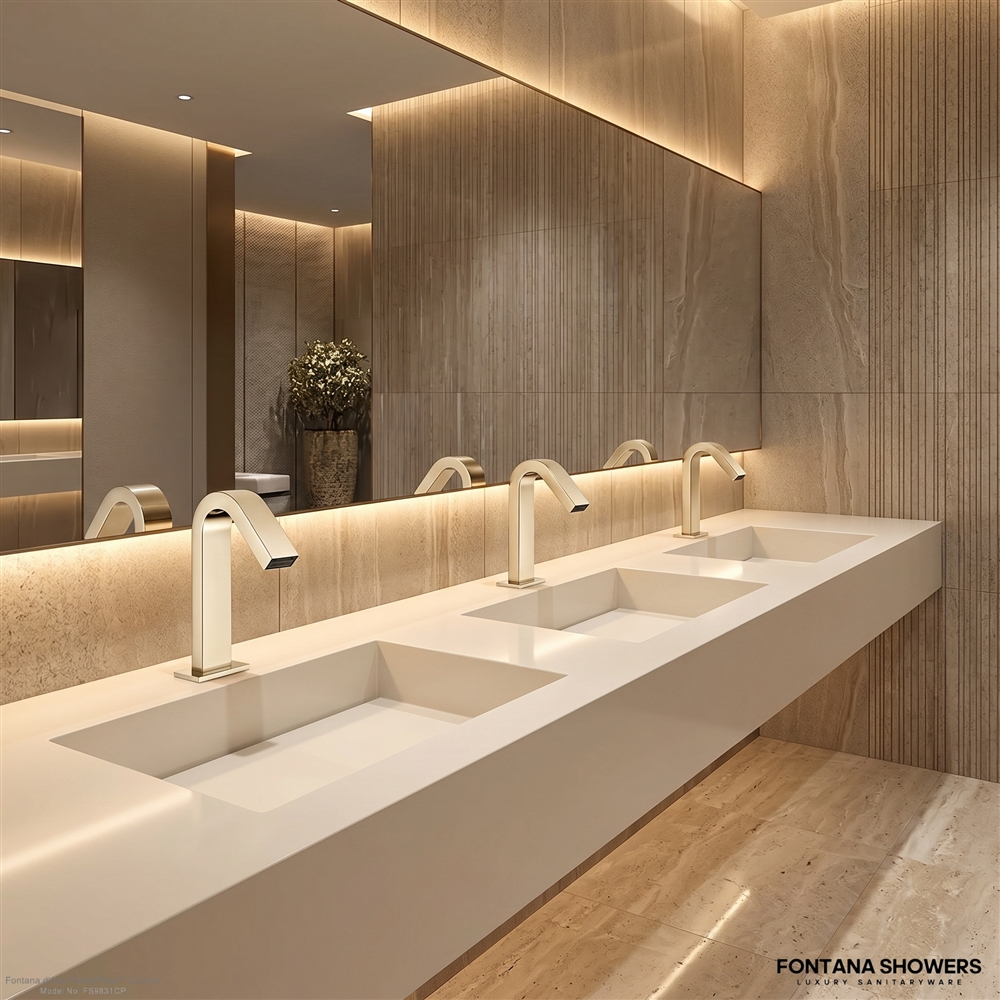
Illustrative multi-user chrome washstation; not a site photograph.
This portfolio context helps designers compare architectural appearance, touchless activation and washstation coordination in demanding public environments.
The performing-arts venue reference emphasizes visitor flow, touchless convenience and centralized soap-system servicing around intermission peaks.
From Design To Operation
Certification documents are most credible when design intentions survive commissioning and occupancy. The architect should coordinate washstation geometry and accessible circulation; the plumbing engineer should confirm flow and water-control performance; the electrical engineer should verify power and protection; the contractor should provide model-accurate installation records; and the facility manager should maintain the systems after handover.
Read More
Each stakeholder contributes evidence that a fixture is actually capable of the function assumed in the green-building strategy.
For venue owners, the stronger business case extends beyond a single utility figure. A restroom that functions consistently may create fewer interruptions, less unnecessary fixture replacement, easier cleaning and a more dignified public experience. Those outcomes need to be monitored rather than presumed. Where smart-restroom data are available, teams may track abnormal flow duration, activation faults, service tickets and water bills alongside attendance, event schedules and cleaning logs. That data can guide recalibration and replacement decisions without overstating the role of an individual sensor.
Ultimately, advanced touchless technology is most valuable when integrated into a complete water, hygiene, accessibility and maintenance strategy. It can help a LEED project document efficient plumbing systems and help a WELL project implement a stronger hygiene-support environment. The defensible claim is not that technology guarantees certification; it is that a properly selected, installed and maintained system creates better opportunities to meet verified performance goals.
Before Specification Approval
Require a project-specific fixture schedule, current product cut sheets, water-flow test conditions, applicable material and performance standards, electrical details, accessibility review, commissioning checklist, and operations manual. The sustainability consultant should confirm credit applicability against the exact LEED and WELL versions registered for the project.
Project FAQs
Do sensor faucets automatically earn LEED points?
No. LEED is a whole-project assessment. Touchless products can support water-efficiency design goals when their rated performance and the project’s calculation method meet the selected rating-system requirements. No credit or points can be presumed from sensor activation alone.
Can touchless fixtures help with WELL v2?
Yes, where the selected WELL feature and project scope call for hands-free bathroom equipment or effective handwashing provisions. W08 Hygiene Support is a relevant starting point, but soap access, accessibility, cleaning practices and documentation remain essential.
Should public lavatory faucets carry a WaterSense label?
EPA WaterSense faucet labeling is intended for specified private-lavatory and bar-sink applications, not ordinary public-lavatory faucets. Public-use lavatories should be evaluated against the appropriate public-use flow and plumbing-code requirements, commonly 0.5 gpm or less.
What matters most for stadium restroom performance?
Dependable sensor activation, controlled water flow, adequate washing time, accessible layouts, stocked soap, serviceable parts, suitable power architecture and maintenance procedures. Actual conservation depends on user demand, settings, pressure and observed operation.
REFERENCE LIBRARY
Related Reading
Browse commercial restroom design, water-efficiency engineering and large-venue operations resources by topic.